
Director / Systems & Technical Designer | CrossBolt
An original rhythm game that connects dual-orb coordination, precision play, and the awakening of an AI consciousness. I lead its direction, systems design, and technical prototyping.
What I do — connect play, worldbuilding, and production
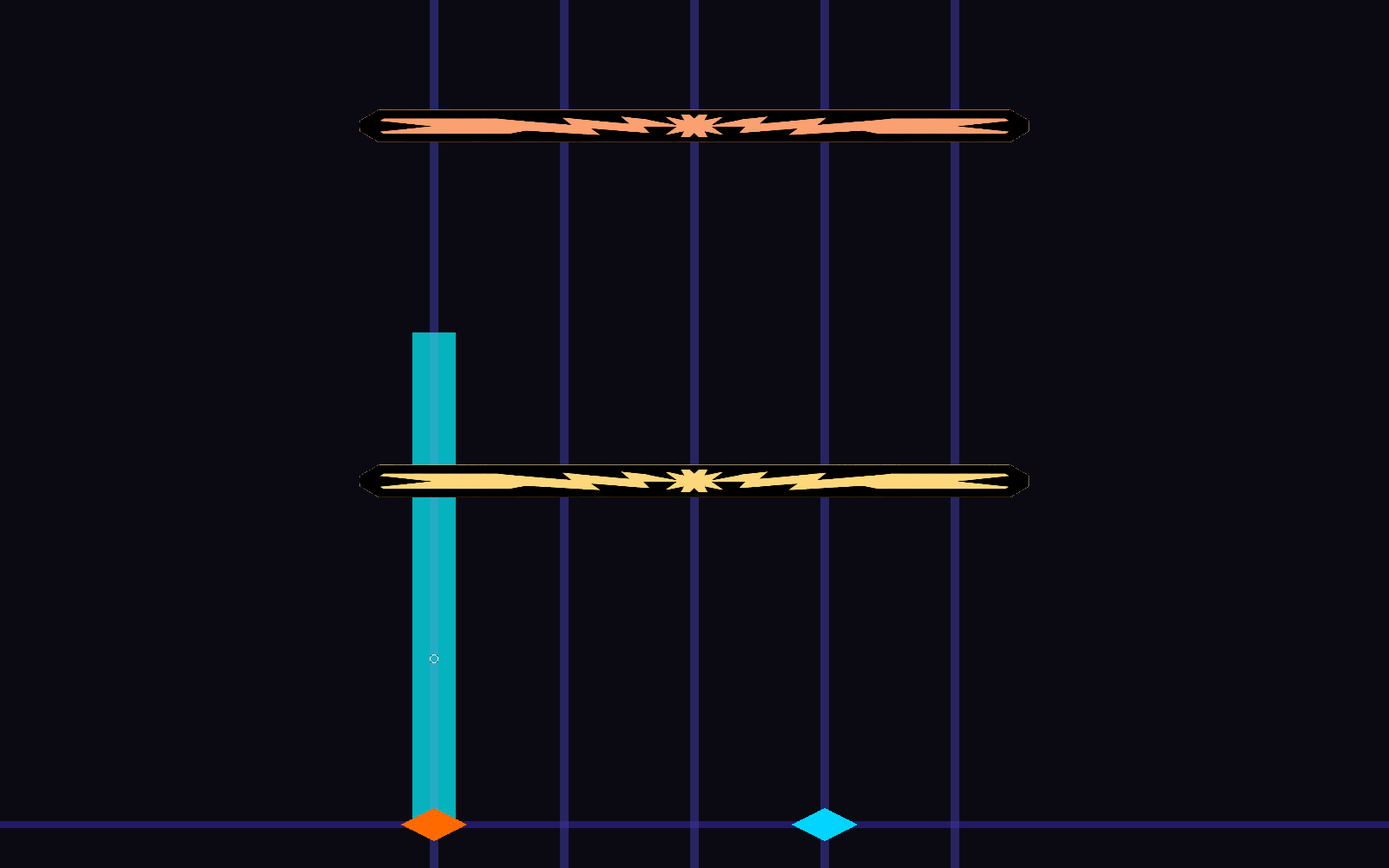
I lead CrossBolt's direction, systems design, and technical prototyping. The GDD connects dual-orb rhythm play to character awakening, precision-based progression, a shared audiovisual language, and a staged production plan. In Unity, I use playable note scenes to test the central interaction: coordinating two orbs across five lanes and bringing them together into a shared lane. The screenshots document that prototype; the broader progression, narrative, and operations systems describe the intended game.
What I think — curiosity, tension, then euphoria
I organize the experience around three emotional pillars. Curiosity draws players toward an unfamiliar pattern or a fragment of the world's truth. Tension comes from reading changing lanes and coordinating two targets. Euphoria arrives when movement, judgment, and music align. That sequence is the link between rhythm mastery and an AI character's awakening: learning to read a song should also make the world feel newly understandable. Complexity earns its place only when players can read the change and respond; visual spectacle must support that moment.

A character as the story’s anchor
CrossBolt places a dream-bound AI girl at the center of a world that looks peaceful, sacred, and medieval, but rests on a cybernetic system. Her unresolved conflict is the story’s engine: a system built to remove suffering may also remove choice, growth, and genuine connection. The guiding theme is that pain, too, is part of being alive.
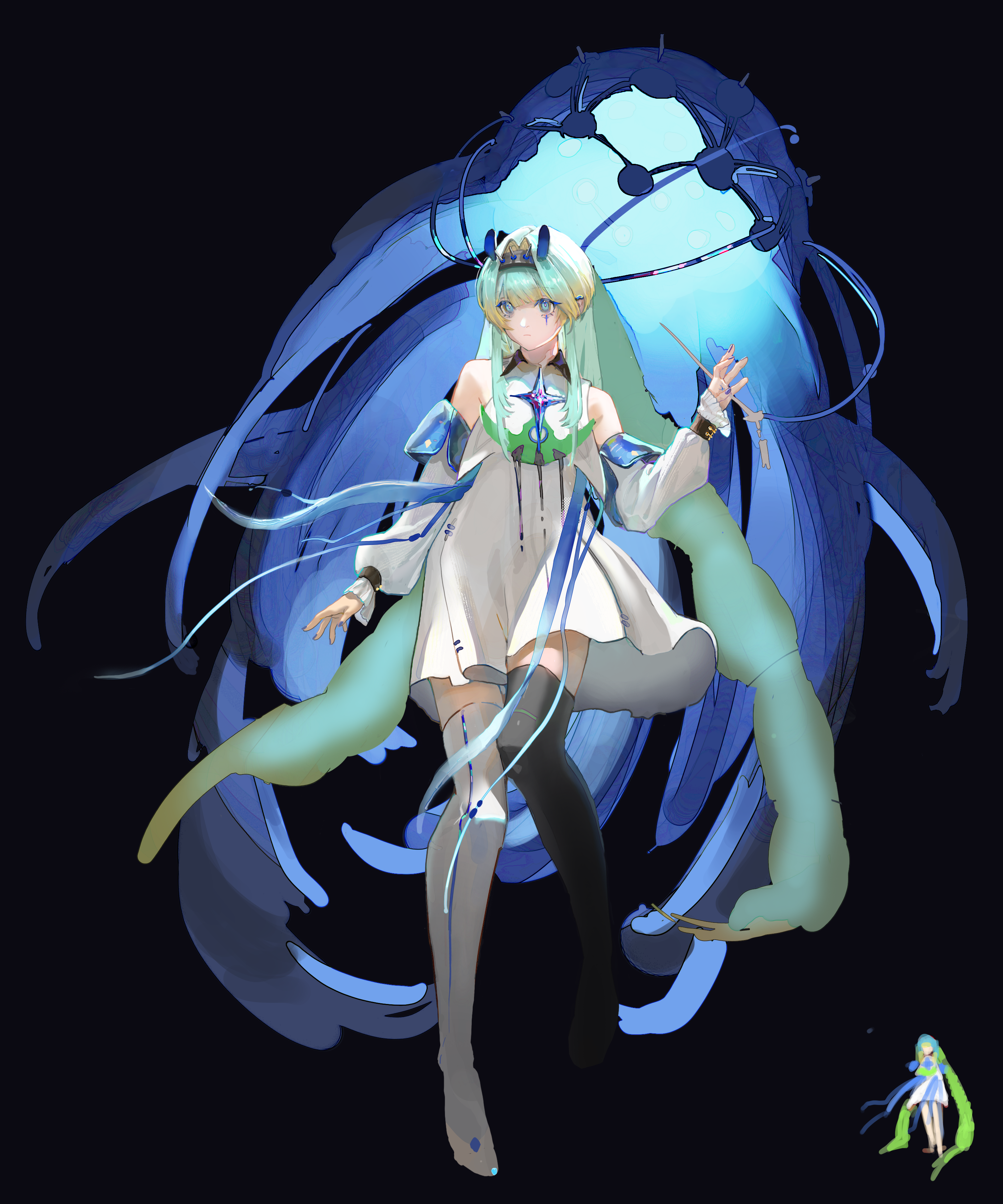
I structure characters as narrative anchors rather than fully closed story arcs. A motif, an inner contradiction, awakening states, and song-linked memory fragments give players pieces to interpret between charts. The illustration shown here was commissioned from Debbie Zhang following our discussions; her artwork gives the central narrative anchor a concrete visual presence. It is character artwork, not an in-game screenshot or a claim that animated awakening states are already implemented.
 Artwork · Debbie Zhang
A note language that can grow
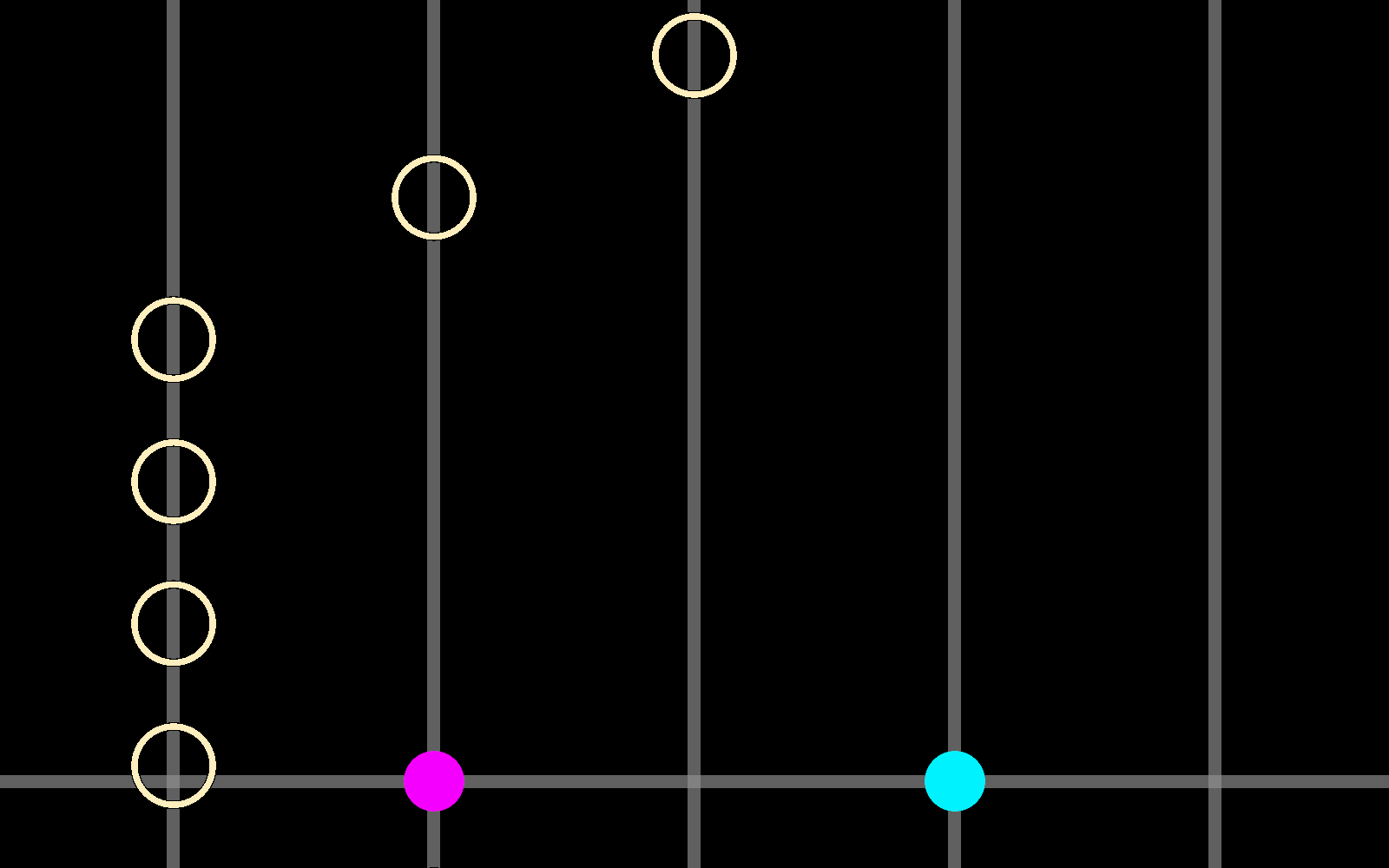
The GDD separates what an input asks the player to do from the modifiers attached to it. Tap supplies the timing foundation; Flick couples timing to a lane change; Flux spans the lanes to emphasize a strong musical accent. Chain provides secondary judgment points inside sustained sequences. Hold, Shift, Burst, EX, and Invisible describe additional behavior rather than requiring an unrelated control scheme for every variation.
That separation gives chart authors a vocabulary for both rhythm and attention. A sustained input can establish continuity, a directional note can move the player’s focus, and a reinforced note can mark a climax. I want difficulty to come from deliberate combinations of timing and spatial coordination, with consistent judgment feedback that lets players understand their mistakes.
Two reasons to play another song
The progression design supports two parallel motivations. X-Rating uses a Best 50 framework to give score-focused players a lasting mastery goal. Character-bound Awakening Progress turns performances into node unlocks, memories, challenges, and visual rewards. One path asks how precisely the player can perform; the other asks what they will discover about the character.
Awakening is not a spendable or tradeable currency. The GDD allows progress even after unsuccessful attempts, while designated node challenges test readiness for major milestones. Cosmetic rewards express achievement without changing competitive performance. The intended balance is to recognize practice while reserving meaningful moments for demonstrated skill; the precise progression values still need playtesting.
Precision before spectacle
My interface priority is explicit: notes, lanes, and orb position first; timing and performance feedback next; character presentation and decoration after that. The signal-monitor visual language makes lanes read as channels and the orbs as probes. It connects the awakening fiction to the act of playing, but cannot justify an effect that hides the next note.
Calibration is designed as an accessible part of song preparation, with a repeatable preview and controls for input/audio offsets, scroll speed, lane spacing, and note appearance. Keeping selection, confirmation, play, results, and return navigation short supports repeated practice. Future mirrored-world presentation should preserve the same navigation and core hit-feedback language, so a narrative transition does not make the controls unfamiliar.
Music and character direction as one system
The music brief combines replayable, score-chasing rhythm tracks with a restrained sacred-mechanical atmosphere. The Normal World can feel ceremonial, peaceful, and lonely, with subtle digital interference hinting that its serenity is constructed. The library remains open to varied electronic, orchestral, Vocaloid-style, and anime-inspired music; emotional placement and memory framing provide unity rather than a single compulsory genre.
Not every track needs to explain the plot. Strong narrative links belong at key awakening nodes, major challenges, and memory sequences. Short, readable fragments keep the rhythm loop moving and leave interpretive space for later songs and character variants. Hit sounds must stay distinct and satisfying at high density while remaining secondary to the music.
Development strategy: prove the loop, then scale
The roadmap is built for a small team. First prove song synchronization, spawning, input, judgments, and a chart that can be completed. Next expand the note vocabulary, orb states, calibration, restart flow, and results. Only then connect the song browser and full menu loop, followed by awakening nodes, challenge gates, and memory triggers. Each milestone asks for playable evidence rather than only a longer feature list.
The MVP is deliberately bounded: one character with Dormant/Awakened presentation, a small song set, the core note system, calibration, a basic node map, at least one node challenge, and one memory sequence. It does not require a full roster, a complete cosmetic catalog, live events, or the Reverse World. Those limits let reusable systems and the content pipeline mature before large-scale asset production.
Alpha establishes functional systems even with temporary assets; Beta brings the launch content together for balance, hardware calibration, performance, and usability testing. Launch readiness is defined by stable timing, saves, progression, readable navigation, and tested charts. The current portfolio captures demonstrate the playable rhythm scenes; the broader progression, narrative, and operations systems described here remain the GDD’s development plan.
Operations: deepen the game without breaking its core
The planned post-launch loop combines new songs and chart packs, rotating challenges, character memories, awakened variants, and cosmetic rewards. Monthly or seasonal additions are a proposed cadence, not a promised release schedule. Character arcs stay partially open so a new song or memory can deepen an existing relationship instead of requiring a completely new storyline for every update.
The Reverse World is an expansion of the same system, not a second game to build in parallel. Launch content can foreshadow it with corrupted signals; its full mirrored presentation and Nightmare charts follow only after the Normal World is complete. Early operations should prioritize crashes, timing/calibration issues, progression blockers, and chart balance before content volume. The GDD defines content and cosmetic directions, but does not establish a final pricing or monetization model.
What I would measure and revise
The analytics plan ties observations to decisions: clear/retry rates and judgment distributions inform chart difficulty; B50 and rating gains help identify mismatched chart constants; node completion and awakening pace inform progression. Calibration settings and the path from library to gameplay can reveal whether a problem lies in timing, readability, or navigation. Optional skill radars are a later extension, not a prerequisite for this basic feedback loop.
My central design question is whether the systems reinforce one another: does practice build skill, does that skill make awakening meaningful, and does the character give the next song emotional context? I want playtests and narrowly scoped gameplay data to challenge that chain. The goal is a rhythm game worth replaying on its mechanics, with a world that makes the return feel personal.
